
Proof, not promises: why sustainability claims need evidence.
Posted • November 17, 2026

Sustainability has become an increasingly important part of how tourism and hospitality businesses present themselves. From accommodation providers highlighting their environmental credentials to venues responding to clients’ ESG requirements, businesses are under growing pressure to demonstrate their commitment to sustainability.
But as expectations rise, so does the need to back up those claims.
A new guide, Proof, Not Promises: A Practical Guide to the EU Empowering Consumers Directive for Destinations, published by the European Travel Commission (ETC), NECSTouR and the Global Destination Sustainability Movement (GDS-Movement), highlights a significant shift in how sustainability should be communicated across the tourism and events industry.
The message is straightforward: sustainability claims need to be supported by evidence, with businesses able to demonstrate what they are doing, how progress is measured and what impact their actions are having.
New regulations on sustainability claims and greenwashing
The guide responds to the EU’s Empowering Consumers for the Green Transition Directive (EmpCo), which has applied across the EU since 27 September 2026. The legislation strengthens consumer protection against misleading environmental claims and introduces stricter requirements for how businesses communicate their environmental credentials.
Generic claims such as ‘eco-friendly’, ‘green’ and ‘environmentally responsible’ are subject to greater scrutiny. Businesses must be able to substantiate the environmental benefits they claim, rather than relying on broad statements that could mislead consumers.
For UK tourism businesses, the Directive is particularly relevant if they market to consumers in EU countries. UK businesses must also comply with existing UK consumer protection and advertising rules, including the Competition and Markets Authority’s Green Claims Code, which requires environmental claims to be truthful, clear and supported by evidence.
This is not simply a change for marketing teams. It has implications for how businesses collect sustainability data, monitor performance and manage information across their operations.
How tourism businesses can measure and demonstrate sustainability progress
Many tourism businesses are already taking steps to improve their sustainability, from introducing energy-saving measures and reducing waste to changing purchasing practices and supporting local suppliers.
The challenge is making sure these activities translate into credible, demonstrable progress.
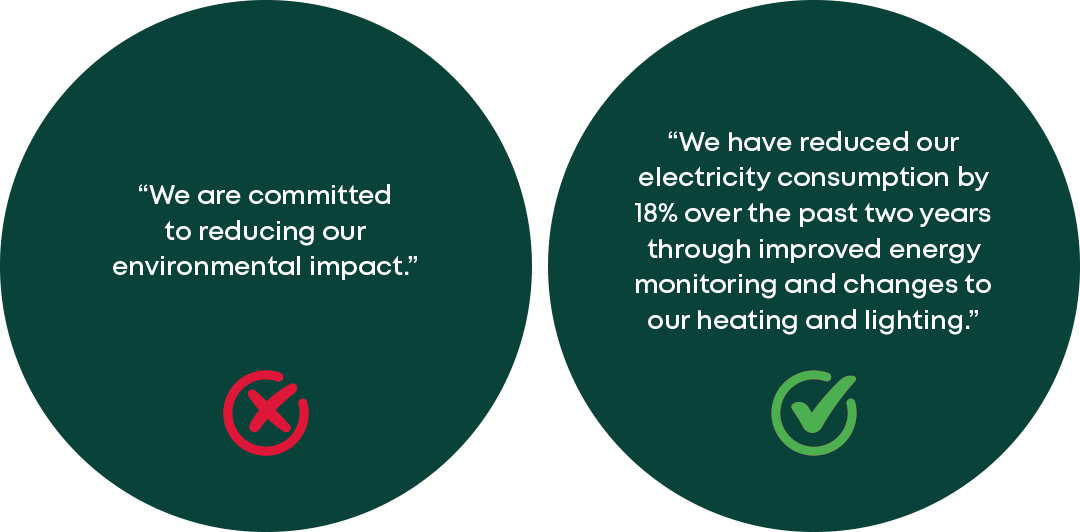
Consider the difference between saying:
‘We are committed to reducing our environmental impact.’
And being able to explain:
‘We have reduced our electricity consumption by 18% over the past two years through improved energy monitoring and changes to our heating and lighting.’
The second statement provides something tangible. It identifies what has changed and gives customers and other stakeholders a measurable result.
This is where good sustainability management becomes essential. Businesses need to understand their starting point, identify areas for improvement and monitor results. Without reliable information, it becomes difficult to demonstrate whether initiatives are making a difference.
Carbon measurement is one example. Understanding emissions across Scope 1, 2 and 3 can help businesses identify their biggest impacts, establish meaningful reduction targets and report on progress. The same principle applies to energy and water consumption, waste, purchasing and wider social and environmental performance.
The business benefits of measuring sustainability performance
Although changing regulations provide an important reason to review sustainability communications, the benefits of having reliable evidence go much further.

Building customer confidence: Customers increasingly want to understand the environmental credentials of the businesses they choose. Clear, specific information helps build trust and gives people a better understanding of what a business is actually doing.
Winning business: Sustainability credentials are becoming increasingly relevant in corporate procurement, tenders and event planning. Hotels, venues and tourism suppliers may be asked to provide information about their environmental performance, carbon emissions and wider ESG commitments. Having this information readily available can help businesses respond to these requirements and demonstrate their credentials.
Strengthening supplier relationships: Businesses are also being asked to understand the sustainability performance of their supply chains. Looking beyond their own premises and considering the environmental and social impacts of purchasing decisions can help them make more informed choices.
Identifying cost savings: Collecting and reviewing sustainability data can highlight inefficiencies and opportunities to reduce operating costs. Monitoring energy consumption, for example, can reveal where improvements to heating, lighting or equipment could reduce both emissions and bills.
How sustainability certification builds business credibility
The Proof, Not Promises guide also highlights the importance of credible sustainability certification and independent verification.
Not all sustainability labels and schemes offer the same level of assurance. A credible certification should have clearly defined criteria, a transparent assessment process and appropriate independent verification.
For tourism and hospitality businesses, certification can provide a structured way to manage and demonstrate progress across different areas of sustainability.

Green Tourism Certified supports this approach through its practical ESG framework, comprising 10 modules covering key areas of responsible business management. Businesses work through the criteria with support from a Green Tourism Support Advisor, with certification assessed through an independent third-party audit.
This gives businesses a clearer structure for understanding their responsibilities, identifying improvements and building evidence of their sustainability performance.
How to make credible sustainability claims: five practical steps
Tourism and hospitality businesses can take practical steps to make their sustainability communications more credible:
- Review existing claims: Check your website, social media and marketing materials for broad statements such as ‘eco-friendly’ or ‘sustainable’. Make sure you can explain exactly what they mean.
- Be specific: Explain the actions you are taking, what has changed and what you are working towards.
- Collect evidence: Keep records of energy and water use, waste data, carbon calculations, purchasing decisions and improvements made.
- Set realistic targets: Make sure future commitments are supported by credible plans and a way of measuring progress.
- Check supplier claims: Understand the evidence behind environmental claims made by suppliers and partners, particularly if you repeat them in your own communications.
The shift towards evidence-based sustainability communication presents a challenge, but also an opportunity. Businesses that invest in understanding their impacts, monitoring performance and building robust sustainability practices will be better placed to demonstrate their credentials to customers, clients and partners.
Ultimately, credibility comes from the work taking place behind the claims. By putting the right processes in place to measure, monitor and verify progress, tourism and hospitality businesses can communicate their sustainability achievements with greater confidence.
Because in a sector where trust matters, proof is more powerful than promises.
Share this story
Related news & insights
Recent posts
November 17, 2026
November 13, 2026
November 12, 2026
In practice
November 13, 2026
Marketing Calendars
October 20, 2026
April 15, 2026
Connect with us
Support